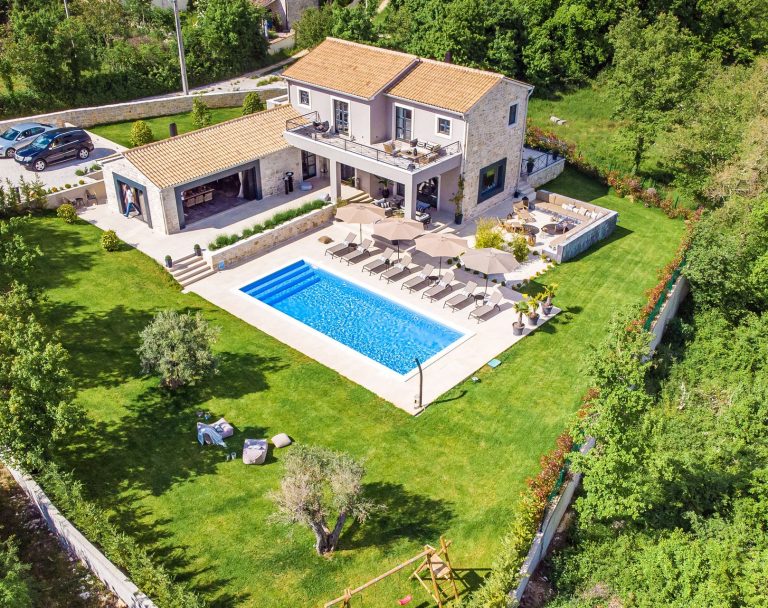
Buying real estate, especially a luxury seaside villa or a hillside residence with panoramic views, begins with a thorough verification of the construction site and the investor. Proper due diligence reduces risks, protects your capital, and ensures that your real estate investment rests on a solid legal and technical foundation.
Quick check of the plot and location
The first step is aligning the land registry and cadastral records. In the land registry, check:
- who is registered as the owner (title deed, Section B),
- whether there are encumbrances such as mortgages, dispute notices, or easements (Section C),
- consistency of the surface area and cadastral parcel number with cadastral data.
If the data are not aligned, request clarification and a clear plan for resolution. For seaside properties, pay special attention to the maritime domain boundary and any concessions; first-row-to-the-sea properties require clear evidence that the building and access are not on maritime domain land, or that a valid decision permits such use.
Reviewing spatial planning documents (GUP/UPU/PPU) confirms land use designation, permitted number of floors, building coefficients, and distance from the coastal zone. This prevents purchasing land or buildings that deviate from planned use.
Permits and documentation on the construction site
A legitimate construction site must have a building permit aligned with the main design project. On-site, this is identified by the construction notice board displaying details of the investor, contractor, supervising engineer, and the permit number and date. Request:
- a certified copy of the building permit and proof of its final validity,
- proof of commencement of construction,
- the main design project with stamps of licensed designers,
- decisions and approvals from utility and other authorities (connections, access road, fire protection, environmental protection).
If the building is completed or near completion, verify the occupancy permit and energy certificate. These are key proofs that the building was constructed in accordance with the project and regulations and is safe for use.
Status and credibility of the investor
A reliable investor leaves a transparent trail. Check the court register for legal status, ownership structure, registered office, and authorized representatives. Reviewing publicly available creditworthiness indicators (e.g., account blocks or basic financial indicators) provides insight into business stability and the ability to complete the project.
Request:
- a reference list of previously completed projects,
- contacts of previous buyers or partners,
- proof of construction site insurance and contractor warranties,
- licenses and professional memberships of experts involved in the project (architects and engineers registered with relevant chambers).
Bank guarantees for advance payment refunds or project completion, as well as transparent payment mechanisms, are strong indicators of seriousness.
For property examples, consider researching a modern luxury villa in an excellent location near Zadar.
Compliance with coastal and protected-area restrictions
Luxury coastal properties are often subject to special regulations. Check whether there is:
- nature protection (Natura 2000, nature park) and special construction conditions,
- conservation requirements if the property is a cultural asset or within a protected area,
- restrictions related to sea access, moorings, and maritime structures.
These elements significantly affect the property’s condition, future usability, and long-term value.
Contractual security before payment
The legal aspect of purchasing real estate requires precise contractual clauses. In practice, the most useful are:
- an escrow account or notary/trust deposit of funds until conditions are met,
- a tabular statement from the seller enabling ownership registration,
- registration of the preliminary contract in the land registry to protect your rights until the main contract is signed,
- clearly defined construction deadlines, phases, and penalties for delays,
- warranties for hidden defects and post-sale support.
For apartments and villas within larger projects, verify proper condominium subdivision (etažiranje) and correctly defined individual units with corresponding shares in common parts.
If you are considering purchasing a luxury exclusive villa, this guide to a designer seaside villa with four bedrooms can help you understand key aspects of such properties.
Technical aspects of luxury villas and hotels
Beyond legal status, the actual condition of the construction site determines quality of life and return on investment. Pay attention to:
- infrastructure: legal and sufficient connections to electricity, water, and sewage; stormwater management solutions,
- access: public road access, width and slope, parking; for hillside villas, terrain stability and a geotechnical report,
- microlocation: sun orientation, protection from strong winds (bura), privacy, and noise levels,
- security: video surveillance, burglar-resistant joinery, fire protection systems,
- additional amenities: pool, spa, smart installations, storage for boating equipment; for hotels and marinas, examine concession regimes and operational permits.
For high-potential luxury investment projects, this first-class luxury villa project on the island of Hvar can serve as inspiration.
Concise checklist for status verification
- Clean ownership and alignment in the land registry; no disputes or encumbrances that hinder transfer.
- Cadastral records, parcel boundaries, and actual site conditions match.
- Valid building permit, construction notice board, and commencement of works registered.
- Compliance with spatial plans, without deviations in use or dimensions.
- Investor legally compliant, financially stable, with verifiable references.
- Contractor and supervision properly licensed; project signed by authorized professionals.
- For coastal properties: clear maritime domain boundary and resolved sea access rights.
- Contractual protections: escrow, registration of preliminary contract, tabular statement, bank guarantees.
- Upon completion: occupancy permit and energy certificate.
When documentation, permits, and the investor’s reputation are aligned, purchasing real estate becomes a secure and well-considered investment, and the chosen home—whether in the first row by the sea or on a sunny hillside above the bay—retains its value long term and offers carefree use.